Tuesday, July 28, 2015

Sophia Fahs


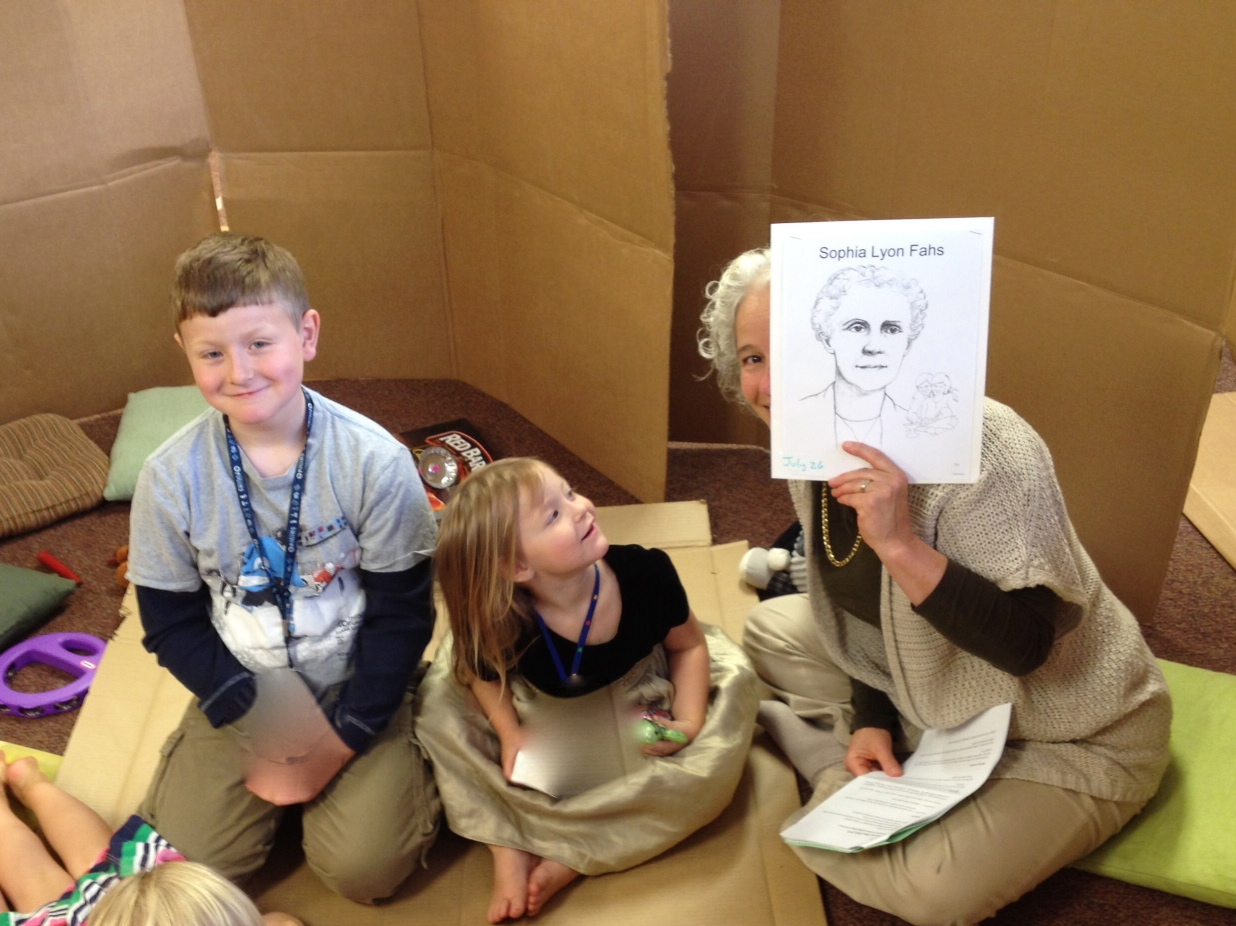
Our guest today was Sophia Lyon Fahs.  As a teacher, writer, editor, and advocate, Sophia Lyon Fahs (1876-1978) helped to revolutionize American children's religious education—and played a major role in what is often called the "Unitarian renaissance" of the 1940s.  She believed children had the capacity to ask big religious questions, and to begin to understand big religious concepts.  Largely because of her influence, Unitarian religious education moved from a model of memorizing religious doctrine, to exploring religious questions together.  Sophia recognized the power of children's creativity, and used their own curiosity as much as possible in designing religious education experiences for children.

Our children explored their creativity today by creating a fort and other objects from cardboard.  On their own the came up with the list of rules posted on the fort.  I think Sophia would be proud!


Creating Space


Our Lighthouse building has undergone some major rennovations over the past month, with more to come!  Our front doors now have windows, to be more inviting as you approach the building (and to cut down on the possibility of smashing an unseen child as you are exiting!)


Rotted foundation under the nursery floor was replaced . . . 


. . . . and a new Dutch Door added


During construction our new front doors were unusable


because the entire front deck was removed to access the foundation!


Each classroom now has a window in the door.


Our new front doors


and our finished nursery!

Monday, July 20, 2015

Lewis Latimer's Bright Idea


You've probably heard of Thomas Edison, the man who invented the lightbulb? People wanted that kind of magic in their own homes. They wanted to be able to flip a switch and have light, just like that! But, there was one problem. Thomas Edison's lightbulb used carbon thread for a filament—that little curly line inside the lightbulb—and the carbon thread lasted only about forty hours before it burned out. Once the filament burned out, the lightbulb would never work again. People would have to buy a new lightbulb. Nobody wanted to buy new lightbulbs all the time. They were expensive. So people gave up on the idea of having electric lightbulbs in their homes, and kept on using candles an kerosene lamps.

But I didn't give up on the idea of electric lightbulbs. I was sure there was a way to make it work. I decided I would find a way to make a longer-lasting light, a light that people could afford to buy for their homes.
I knew it wouldn't be easy.  I'd only been to a few years of elementary school before I had to get a job to help support my family, when I was only ten. Life was hard for my family. 

I figured out that whatever I wanted to learn, I could find out from books or by teaching myself what I wanted to know. I worked in a patent office, a company that helps inventors. The company I worked for drew the pictures for the patents. I helped Alexander Graham Bell draw diagrams of the telephone and get the patent on that. I liked to do experiments, and I had also invented some things myself. Even though I didn't have a college degree or a high school education, I was a scientist and an inventor and an engineer.

So I decided I could figure out how to make a longer lasting lightbulb. And I did it! I designed a carbon filament that was baked in a special way and so lasted for a long, long time, hundreds of hours. I received a patent for my carbon filament, which means the United States government recognized that I was the inventor, the very first person to create that carbon filament.

Electricity wasn't the only type of light I helped to create. I loved leaning new things and teaching others. I believed in sharing the light of truth. I helped people who were hungry or were poor, just like my family had been. I knew that helping others was another way of sharing light.

In one of my poems I wrote:
To love while we live
And give aid to each other
Is the sunshine of life
That turns night into day.

In 1908 I helped to start a Unitarian church in New York. People still go to that church, over a hundred years later. That Unitarian Universalist church—just like this Unitarian Universalist church—gives a long and lasting light. I knew of Unitarians all my life. My parents had been helped by Unitarians, and the Unitarian beliefs in the importance of character, the toleration of different views, and the enthusiastic approach to learning matched my own views well. My wife and children and I were all active Unitarians.


I'm proud of the things I created that made a difference in the world. I wonder what you might create that will also help to make a difference?
(Adapted from A Lamp in Every Corner by Janeen K Grohsmeyer).

Monday, June 22, 2015

Norbert Capek: The Man Who Loved Beauty


The children's class enjoyed a visit from Norbert Capek, the creator of the flower communion.  


We made musical instruments from recycled materials.  Norbert Capek had a large, musical family.  They had enough musicians to make their own family orchestra.


We made tissue paper flowers and celebrated our own flower communion.

Norbert described the first flower communion, held at his church in Prague, "We put a big table in the middle of the worship space, and on it a large vase. The vase represented the Unitarian church, which helps everyone in the congregation share the beauties in life. Each person had been told to bring a flower along that Sunday, and each put his or her flower in the vase. In my sermon, I talked about how each and every flower was different and important, just like every person in my congregation. And yet they all belonged together in one community, as sisters and brothers. In this Unitarian community, when they gave their best that was in them for the good of everyone, they were able to do together what no one person can do alone."

Monday, June 15, 2015

Who Is A Super Hero?


This summer we will be learning about some Unitarian Universalist super heroes. We are calling them heroes because they tried to live their lives so that their abilities and talents became “super powers”, and they tried to use these powers to make the world a better place.


Are people heroes because they're strong? Or fast? Or famous? What heroes can you think of who have done something that helped others?


Children were asked to think of something heroic they have done or might like to do, or of something heroic they have seen someone else do in real life. Maybe someone has saved a bird’s nest from a cat, or helped get first aid for someone who fell off their bike, or cleaned up a spill so people wouldn’t slip and fall. Maybe someone ate lunch with a new child at school.   


Children developed their own super hero costumes, and wrote and drew about their own super hero powers.  If they were a super hero, what powers would he or she have? What sort of costume would reflect these powers?  Look at the fantastic personas we developed!

Even our youngest children can be super heroes!


Super teachers!


Monday, May 18, 2015

Lighthouse Open House

Today was our open house, a time for our children and youth to share what they have been doing and learning in their classes this year.

Discovery Class shared some of the stories they have enjoyed from our six sources:  wonder and awe, words and deeds of prophetic men and women, wisdom from the world's religions, Jewish and Christian teachings, science and reason, and earth-centered traditions.


Treasure Hunters have enjoyed stories from different religions, created their own stories, and developed ideas about what God is.


Trail Blazers have considered big religious questions, explored how different religions answer these questions, and considered what their own answers to these questions are.


Explorers learned about different religious traditions.  Today they shared a trail mix activity, where visitors could mix together a snack representing which traditions influence their own beliefs.


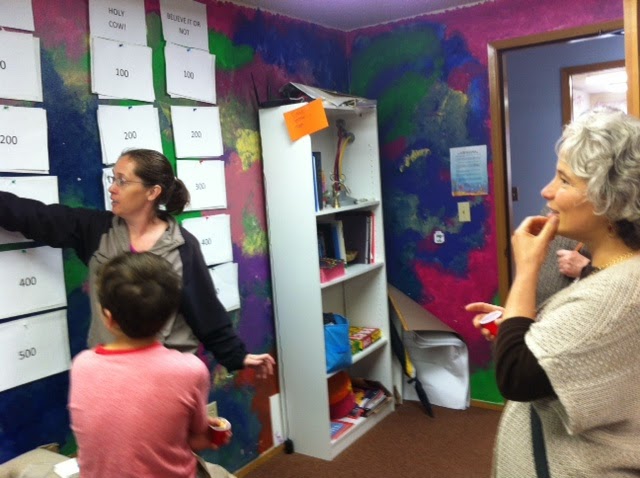
The middle school youth have learned about world religions through visiting places of worship in our community.  They shared a Jeopardy-style trivia game with facts about different religious traditions, as well as some of the religious practices they have learned about.


A big thank you to all of our children, youth, and their teachers for sharing their learning with our community!


Sunday, January 25, 2015

Lighthouse Chapel

The Loving Hearts team prepared birthday cards

The Loving Hearts Team hopes the children and youth with birthdays in the next few months will enjoy receiving a card from their church friends.
The Open Minds team learned about the four elements and built an altar together.

The Open Minds team matched natural items with each of the four elements.
The Helping Hands Team sorted games and toys from our childcare supply closet.

The Helping Hands team encourages you to sort through your toys, clothes, and housewares at home, and bring unneeded but still useful items to the Buy Nothing Swap on February 28.
The newly cleaned and organized toy and game cupboard!