Tuesday, April 17, 2012
The Practice of Prayer
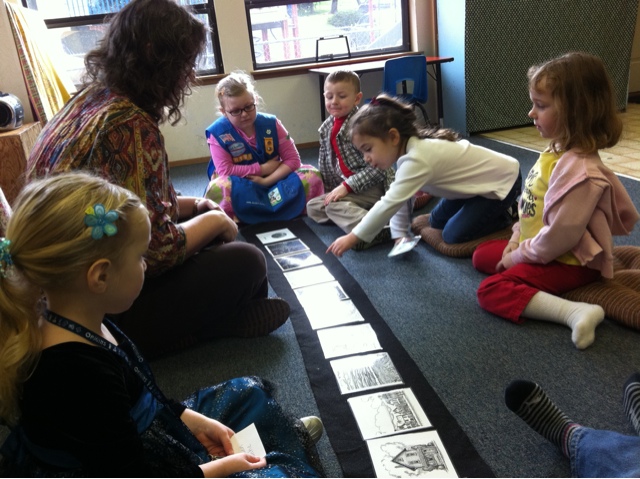
In preparation for visiting a Mosque later this month, our youth group learned about Rakah (Islamic prayer). The youth practiced prayer positions using rugs. Women and girls will need to wear head coverings when visiting the Mosque.
Prayer is not common among all Unitarian Universalists. The idea of prayer can even make some of us uncomfortable. Some of us do pray. Sometimes our prayer takes the form of music. Here, the Spirit Play class sings "Spirit of Life", which could be considered one of our sung prayers.
Monday, March 19, 2012
John Murray
This week, children in the preschool and elementary classes at 11:00 heard the story of John Murray. This story comes from our second source: Stories from the
women and men of long ago and today whose lives remind us to be kind and
fair.
Each story begins with an underlay. As we open it up to create our story space, we wonder aloud with the children what it might represent. "What could this be?
It could be a big blue book.
Maybe it’s a big blue box? Sky is
often blue. Maybe it’s the sky? The ocean can be blue. I think it’s the ocean."
Two green strips of felt were added. These could be land. One
shore on each side of a large ocean. This is a story told about a boy who was born on one of
these shores who when he became a man took the long journey to the other shore.
This boy’s name was John Murray. John became a minister when he grew up. He rode around from city to city teaching
people how to love each other and love God.
Many of the people where John lived believed that God punished people,
sometimes in horrible ways. They also
believed that God only cared about a very few people
But John couldn’t believe that God was angry and punished
people. In fact he was certain that God
was loving. He also had a hard time
believing that God only loved a few people.
God was so big and so loving, John was certain that God loved all
people.
John traveled around letting people know that God loved
them, and that God loved all people, and that God wasn’t angry and wasn’t going
to punish them. But people couldn’t
always believe John. They would get so
angry at him that they would tell him to leave their towns.
John finally decided that he was finished with
preaching. He had many sad things happen
to him and on top of that people didn’t like hearing that God loved them.
John decided that he wasn’t going to preach anymore. He also decided that he was going to leave
his country, which was England,
and take the long journey to America.
John got a job on a boat which was sailing for America. It was a long trip.
Meanwhile there was a man in America, named Potter. Potter was a farmer who owned a lot of land.
Potter had been having the strangest dreams. He began to think that God was talking to him
in his dreams.
Mr. Potter had a dream in which God told him that he
needed to build a church building on his land, near the ocean and that God
would send a preacher who would come and preach from that pulpit. God also told Mr. Potter that the preacher
would preach a wonderful message of love that would change people’s hearts.
Mr. Potter did as he was told in the dream. He built a church building. And then he waited.
The Boat on which John Murray was sailing finally made it
to America
but the water got shallow and the boat got stuck just off shore. They had been traveling for a long time and
had begun to run out of food. So the
captain of the ship asked John to go ashore and buy some food to bring back to
the boat.
John came to shore.
And where was he? He was on Mr.
Potter’s land and he ran into Mr. Potter.
And Potter met John saying the strangest thing. He said, “You are the preacher who will speak
the good news from the pulpit I have built.”
John didn’t know about Mr. Potter’s dream that he was to build a chapel
and that a preacher would come and preach God’s love. But as strange as it all was, John liked Mr.
Potter and spoke with the man for a long time.
He finally admitted that he was a minister and though at first he didn’t
want to, John finally agreed to preach that Sunday.
That Sunday he climbed into the pulpit and told the people
there to go out and give people a glimpse of God’s love. “Give them not hell but hope….” John didn’t stay with Mr. Potter but he did
stay in America
and he did start preaching again. He
founded many churches devoted to spreading the message of love.
We end our story with some wondering questions. These questions are to remind us to wonder, and not usually ones we have answers to. "I wonder if John was ever scared that people wouldn’t like
what he was telling them? I wonder if Mr. Potter ever worried that the preacher
would never come? I wonder if you have ever had a dream like Mr. Potter’s? I wonder what other ways God speaks to people?"
John Murray and Thomas Potter believed in God's love for all people. They helped to found the Universalist Church in the United States. We remember our Universalist ancestors for their bravery, in believing in the goodness of peoople and the power of love.
adapted from the Spirit Play Story "John Murray Coming to America"
Tuesday, March 13, 2012
Spring Celebrations
Our village class at 11:00 celebrated the spring Equinox a little early. We talked about how the earth's path around the sun affects the seasons and the length of the day and night.
In some pagan traditions the moment of equal light and dark, which marks the start of spring, is a holiday called Eostara, named for a Germanic goddess of fertility and growing. The holiday we call Easter not only gets its name from Eostara, it gets a bunch of its traditions as well--such as dying colorful eggs.
We used crayons to color on hot eggs, melting the wax in swirling patterns. Afterwards, we chose other activities, like playing with clay or working with the zen garden. At feast time, we thought about our hopes for the coming year, and imagined that by cracking open our eggs we were helping our dreams for the future to grow.
Our chapel service at 9:30 was also a celebration of spring. We celebrated the Iranian holiday of No Ruz. This holiday falls around the Spring Equinox each year, and is a celebration of the new year. Families assemble an alter with items symbolic of hopes for the new year and new life and growth.
We enjoyed a ritual of throwing green sprouts into a stream to cast away grudges and then jumping over fires and making wishes for the new year.
During our team meeting time, the Caring Hearts team wrote birthday cards for children and youth with spring birthdays.
The Open Minds team colored eggs that were placed on the alter for our chapel service, and then shared with the adults at coffee hour. This team also presented the different objects on the alter for our No Ruz celebration.
The Helping Hands team painted lighthouses that will be appreciation gifts for Lighthouse volunteers this year.
In some pagan traditions the moment of equal light and dark, which marks the start of spring, is a holiday called Eostara, named for a Germanic goddess of fertility and growing. The holiday we call Easter not only gets its name from Eostara, it gets a bunch of its traditions as well--such as dying colorful eggs.
We used crayons to color on hot eggs, melting the wax in swirling patterns. Afterwards, we chose other activities, like playing with clay or working with the zen garden. At feast time, we thought about our hopes for the coming year, and imagined that by cracking open our eggs we were helping our dreams for the future to grow.
Our chapel service at 9:30 was also a celebration of spring. We celebrated the Iranian holiday of No Ruz. This holiday falls around the Spring Equinox each year, and is a celebration of the new year. Families assemble an alter with items symbolic of hopes for the new year and new life and growth.
We enjoyed a ritual of throwing green sprouts into a stream to cast away grudges and then jumping over fires and making wishes for the new year.
During our team meeting time, the Caring Hearts team wrote birthday cards for children and youth with spring birthdays.
The Open Minds team colored eggs that were placed on the alter for our chapel service, and then shared with the adults at coffee hour. This team also presented the different objects on the alter for our No Ruz celebration.
The Helping Hands team painted lighthouses that will be appreciation gifts for Lighthouse volunteers this year.
We enjoyed celebrating the coming of spring!
Tuesday, March 6, 2012
Taoism
Today classes at 9:30 learned about Taoism. Tao means "way." It is pronounced "dow." The way, according to Taoists, is the spiritual force that underlies the universe and is found in all things. Even though it is a part of all things, it is greater than all things. It is the ultimate reality.
The Explorers class explored the idea of Tao and the symbol of the Yin Yang. Each child designed their own interpretation of a symbol to represent balance.
The Treasure Hunters class read a picture book exploring Taoism and then practiced some Tai Chi, a series of meditative exercises for the body.
In Taoism, practice is considered more important than creed. Although different sects do have established doctrines, none is universal. Mediation is an important practice for many believers.
Our Discovery class explored the theme of light today, after examining dark at their last class. This exploration of opposites tied in nicely with our older children's study of Taoism and the balance of opposites.
The Explorers class explored the idea of Tao and the symbol of the Yin Yang. Each child designed their own interpretation of a symbol to represent balance.
The Treasure Hunters class read a picture book exploring Taoism and then practiced some Tai Chi, a series of meditative exercises for the body.
In Taoism, practice is considered more important than creed. Although different sects do have established doctrines, none is universal. Mediation is an important practice for many believers.
Our Discovery class explored the theme of light today, after examining dark at their last class. This exploration of opposites tied in nicely with our older children's study of Taoism and the balance of opposites.
As our Explorers class discussed in the "opposites" card game they played today, there can be opposites, like "light" and "dark" but there can also be everything in between. The opposite of "black" may be "white" but what's in between? One response--a zebra!
At Home In the Universe
Classes at 11:00 explored our first source today--direct experience of transcending wonder and mystery. Children in the Storytime class heard a story about the universe, and it did seem to inspire a sense of wonder! We wondered about how big the universe is, whether there are other universes, and where each of us lives within our universe.
Children in the Spirit Play class also explored our first source today. We made crayon art pictures where the top layer of black crayon is scraped away, revealing colors underneath. The results are unexpected, and get at the idea of mysterious. We can think of the world as being kind of like our pictures – there’s a big picture there that we can’t really see, but we can manage to see through to parts of it. Sometimes science helps us to scrape away the not understanding so that we can see what’s really there, and music and art and imagination can also help us to understand the things that we can’t completely see. (I didn't get any photos of this project, unfortunately.)
And finally, here's some of our littlest ones, at "home" in the nursery, and in the Universe!
Children in the Spirit Play class also explored our first source today. We made crayon art pictures where the top layer of black crayon is scraped away, revealing colors underneath. The results are unexpected, and get at the idea of mysterious. We can think of the world as being kind of like our pictures – there’s a big picture there that we can’t really see, but we can manage to see through to parts of it. Sometimes science helps us to scrape away the not understanding so that we can see what’s really there, and music and art and imagination can also help us to understand the things that we can’t completely see. (I didn't get any photos of this project, unfortunately.)
And finally, here's some of our littlest ones, at "home" in the nursery, and in the Universe!
Tuesday, February 14, 2012
We Drew a Circle
There was a mobile that hung at the back of the sanctuary in the church I attended as a child. A large circle encompassed two balls, one of which was enclosed by a smaller circle. The ball that was closed off was a knotted mass of gold cord; the other had gold spokes extending outwards in all directions. It was a symbol of a poem which I learned when I was about five years old:
I grew up seeing the visual reminder each Sunday, knowing that my church community valued inclusion, respect for differences, and most of all, love.
I grew up, moved away, and fell in love. I came out as a lesbian, and found a great deal of support from people in my local Unitarian Universalist congregation.
Some years later, I heard that my childhood church was considering becoming a welcoming congregation, and that some of the members were uncomfortable with the idea. A welcoming congregation is one that has taken intentional steps to become more welcoming and inclusive of people of all sexual orientations and gender identities. My mom, my girlfriend, and I put together a worship service to present to the church. My mom spoke about her challenges accepting her daughter as a lesbian and her fears that I would encounter so much hate from society. My girlfriend, a seminary student, spoke about Unitarian Universalism and a theology of love. And I told my story of growing up in that church, and learning that all people are worthy of love. I told of learning the poem about the circles, and how I knew that the people in this room understood the importance of including all people in their circle.
At our Lighthouse chapel service at Saltwater Church this past Sunday, the children acted the poem I learned as a child. We used two hula hoops to form the circles and our own bodies to be the people being included and excluded. We talked about the importance of including all people within our circle and that all people are worthy of love.
This week, Governor Gregoire signed into law marriage equality. I cannot tell you what it means to me to have been invited into the circle.
This summer, my wife Katie and I will be allowed to legally marry. I already call her my wife. We were already married by the Rev. James, in a lovely ceremony with our families and closet friends. What difference will the legal right to call our relationship a marriage make?
The Rev. Meg Barnhouse, a Unitarian Universalist minister, is also a singer/songwriter and story teller. Her songs can be funny, and even irreverent, but are deeply rooted in a theology of love. While working in my office on Monday, I was listening to a recording of a concert she performed at General Assembly a few years ago. One of the songs was written for the annual Coming Out Day celebration at her church in South Carolina. This song always strikes a chord with me; the emotions she describes and the challenges of wanting to be true to oneself while not damaging relationships with the people in ones life who don’t approve. This time as I listened, what I was struck by was the love. Between verses about the difficulties of coming out, is the chorus:
This is our work as Unitarian Universalists, the challenge that our liberal faith gives to us. We must embrace differences with love. We must choose to stand on the side of love. While there are important legal and practical implications involved, the biggest difference that marriage equality will make for gay and lesbian families is the message it sends. You are welcome in our circle.
I did not speak with the children this past Sunday about marriage equality. I considered sharing with them a story about people who hoped to win the right to marry. But the story is bigger than that. What I want our children to learn, what I want them to know deep in their souls, is the power of love and the importance of including all people in the circle. Instead of marriage equality, we talked of how it feels when boys or girls exclude other children from their friendships. We talked about how important it is to make the circle of our church community open to everyone. We made valentines for people in our church community that we don’t see often, who can’t get to church regularly due to health reasons or distance or other difficult situations, as a reminder that these people are still part of the circle of our community.
I could have talked about marriage equality. It’s important, and it affects the lives of children. But my prayer is that when they are old enough to marry, this particular form of exclusion will no longer be an issue. I know they will be faced with other struggles which will call out to be embraced with love. My prayer for our children is that they will grow into adults who know there is room for everyone in the circle.
Meg Barnhouse’s song closes with these words, a commitment to stand with those who have been hurt, who have struggled, whose rights have been denied. In doing so, she says our circle is big enough to include you.
When you are approached by people at the grocery store in the coming months, gathering signatures to put gay marriage, please do not sign. Marriage equality is law, and will remain so unless the challenge on the ballot this November overturns it. When you vote this November, I ask you remember the importance of including everyone in the circle with love. Please talk with people in your life, let them know this issue is important to you.
More importantly, whenever you see evidence that people are being excluded for whatever reason, embrace them with love. Work to show them that there is room for all in the circle.
“He drew a circle that shut me out—
Heretic, rebel, a thing to flout.
But Love and I had the wit to win
We drew a circle that took him in.”
--Edwin Markham
I grew up seeing the visual reminder each Sunday, knowing that my church community valued inclusion, respect for differences, and most of all, love.
I grew up, moved away, and fell in love. I came out as a lesbian, and found a great deal of support from people in my local Unitarian Universalist congregation.
Some years later, I heard that my childhood church was considering becoming a welcoming congregation, and that some of the members were uncomfortable with the idea. A welcoming congregation is one that has taken intentional steps to become more welcoming and inclusive of people of all sexual orientations and gender identities. My mom, my girlfriend, and I put together a worship service to present to the church. My mom spoke about her challenges accepting her daughter as a lesbian and her fears that I would encounter so much hate from society. My girlfriend, a seminary student, spoke about Unitarian Universalism and a theology of love. And I told my story of growing up in that church, and learning that all people are worthy of love. I told of learning the poem about the circles, and how I knew that the people in this room understood the importance of including all people in their circle.
At our Lighthouse chapel service at Saltwater Church this past Sunday, the children acted the poem I learned as a child. We used two hula hoops to form the circles and our own bodies to be the people being included and excluded. We talked about the importance of including all people within our circle and that all people are worthy of love.
This week, Governor Gregoire signed into law marriage equality. I cannot tell you what it means to me to have been invited into the circle.
This summer, my wife Katie and I will be allowed to legally marry. I already call her my wife. We were already married by the Rev. James, in a lovely ceremony with our families and closet friends. What difference will the legal right to call our relationship a marriage make?
The Rev. Meg Barnhouse, a Unitarian Universalist minister, is also a singer/songwriter and story teller. Her songs can be funny, and even irreverent, but are deeply rooted in a theology of love. While working in my office on Monday, I was listening to a recording of a concert she performed at General Assembly a few years ago. One of the songs was written for the annual Coming Out Day celebration at her church in South Carolina. This song always strikes a chord with me; the emotions she describes and the challenges of wanting to be true to oneself while not damaging relationships with the people in ones life who don’t approve. This time as I listened, what I was struck by was the love. Between verses about the difficulties of coming out, is the chorus:
“I speak to the beauty in you, to the light in your eyes,
To the pain you disguise, your broken heart
I sing to the beauty in you, we will not lie anymore,
You’ve got your hand on the door, let’s make a start.”
This is our work as Unitarian Universalists, the challenge that our liberal faith gives to us. We must embrace differences with love. We must choose to stand on the side of love. While there are important legal and practical implications involved, the biggest difference that marriage equality will make for gay and lesbian families is the message it sends. You are welcome in our circle.
I did not speak with the children this past Sunday about marriage equality. I considered sharing with them a story about people who hoped to win the right to marry. But the story is bigger than that. What I want our children to learn, what I want them to know deep in their souls, is the power of love and the importance of including all people in the circle. Instead of marriage equality, we talked of how it feels when boys or girls exclude other children from their friendships. We talked about how important it is to make the circle of our church community open to everyone. We made valentines for people in our church community that we don’t see often, who can’t get to church regularly due to health reasons or distance or other difficult situations, as a reminder that these people are still part of the circle of our community.
I could have talked about marriage equality. It’s important, and it affects the lives of children. But my prayer is that when they are old enough to marry, this particular form of exclusion will no longer be an issue. I know they will be faced with other struggles which will call out to be embraced with love. My prayer for our children is that they will grow into adults who know there is room for everyone in the circle.
“Stand up, you are beautiful,
Stand up, we will stand with you.”
Meg Barnhouse’s song closes with these words, a commitment to stand with those who have been hurt, who have struggled, whose rights have been denied. In doing so, she says our circle is big enough to include you.
When you are approached by people at the grocery store in the coming months, gathering signatures to put gay marriage, please do not sign. Marriage equality is law, and will remain so unless the challenge on the ballot this November overturns it. When you vote this November, I ask you remember the importance of including everyone in the circle with love. Please talk with people in your life, let them know this issue is important to you.
More importantly, whenever you see evidence that people are being excluded for whatever reason, embrace them with love. Work to show them that there is room for all in the circle.
Meditation Workshop
This past Sunday, we welcomed a special visitor to the Lighthouse. Sissel, a member of the Puget Sound Zen center, met with our class to share about Buddhism.
Sissel showed us how to pay attention to our breathing. We each placed a beanie baby on our tummy and practiced breathing, watching the animal rise and fall. Paying attention to one's breathing is a first step in learning meditation.
We practiced meditating together, counting how many times Sissel rang the singing bowl. Then we shared what we'd learned about Buddhism in our classes. Sissel was impressed with how much we'd learned and remembered about the Buddha's life.
We played a card game to explore the idea of impermanence. We sorted through the cards to find things that become something else: water becomes ice, young people become old, seeds become plants.
Sissel challenged us to think beyond the concrete. How can something old become young? How can we link a series of cards, so that two seemingly unrelated things are now connected?
We ended with a walking meditation, each person keeping pace with the person before them.
We really enjoyed Sissel's visit and learning more about Buddhism. Thank you Sissel for joining us.
Sissel showed us how to pay attention to our breathing. We each placed a beanie baby on our tummy and practiced breathing, watching the animal rise and fall. Paying attention to one's breathing is a first step in learning meditation.
We practiced meditating together, counting how many times Sissel rang the singing bowl. Then we shared what we'd learned about Buddhism in our classes. Sissel was impressed with how much we'd learned and remembered about the Buddha's life.
We played a card game to explore the idea of impermanence. We sorted through the cards to find things that become something else: water becomes ice, young people become old, seeds become plants.
Sissel challenged us to think beyond the concrete. How can something old become young? How can we link a series of cards, so that two seemingly unrelated things are now connected?
We ended with a walking meditation, each person keeping pace with the person before them.
We really enjoyed Sissel's visit and learning more about Buddhism. Thank you Sissel for joining us.
Subscribe to:
Posts (Atom)